
Introducing Atatus Sensitive Data Classifier

Your logs know too much.
Every debug statement, every traced request, every APM span can carry the risk of capturing something they shouldn't. A customer email. A JWT token. A credit card number. An API key that was never meant to leave your payment service.
It doesn't look like a breach. There's no alert. Your observability platform just quietly accumulates sensitive data like indexed, replicated, and accessible to every engineer with log query access.
That's exactly the problem Atatus Sensitive Data Classifier solves. It automatically detects, classifies, and redacts PII, credentials, and regulated data across your logs, traces, and RUM events at ingestion, before anything hits storage.
What You’ll Explore?
- The Hidden Security Risk Inside Your Observability Pipeline
- Why Traditional Log Monitoring Fails to Protect Sensitive Data
- How Atatus Sensitive Data Classifier Works
- What Gets Detected Out of the Box
- Real-World Scenarios Where Sensitive Data Leaks Into Observability
- How Atatus Protects Sensitive Data Across Logs, Metrics, and Traces
- Compliance Coverage: GDPR, HIPAA, PCI DSS, and SOC 2
- Best Practices for Secure Observability
- Security and Compliance Checklist
The Hidden Security Risk Inside Your Observability Pipeline
A developer adds a debug log line to trace a payment failure. An SRE tail logs a Kubernetes pod during an incident. A distributed trace captures a full HTTP request header including a Bearer token.
None of this was intentional. All of it is a data breach waiting to happen.
⚠️ "Sensitive data exposure in logs is one of the most underestimated attack surfaces in modern cloud infrastructure. "
Engineering teams instrument everything including APIs, microservices, databases, queues and that instrumentation inevitably captures PII, secrets, and regulated financial data. Your observability platform becomes an unintentional archive of your most sensitive information.
The consequences are severe: GDPR fines, HIPAA violations, PCI DSS audit failures, and the reputational cost of a credential leak that powers a downstream breach. And unlike an exposed S3 bucket, sensitive data in logs hides in plain sight, often for months before anyone notices.
This is why we built the Atatus Sensitive Data Classifier.
Protect sensitive telemetry data before it reaches your observability pipeline
Stop accidental PII leaks in logs, traces, and RUM events at ingestion time.
Why Traditional Log Monitoring Fails to Protect Sensitive Data?
Most log management tools were built to answer one question: what happened? They were not built to ask: should this data even be here? The result is a predictable failure pattern:
- No ingestion-time scanning. Data is stored first, filtered (maybe) later. By then, it's already indexed, replicated, and potentially accessible to anyone with log query permissions.
- No data classification. Tools flag anomalies in metrics but have no concept of what constitutes sensitive data in a log payload.
- Manual redaction is error-prone. Requiring developers to sanitize logs before shipping is like requiring them to never make mistakes, it doesn't scale and it doesn't work.
- Third-party destinations multiply risk. When logs flow to external SIEMs or cloud storage, every unredacted PII field travels with them.
Traditional observability treats security as someone else's problem. That approach is incompatible with modern compliance requirements and the threat landscape teams face today.
How Atatus Sensitive Data Classifier Works?
The classifier operates in four precise stages, all executing in-stream before a single byte reaches storage.
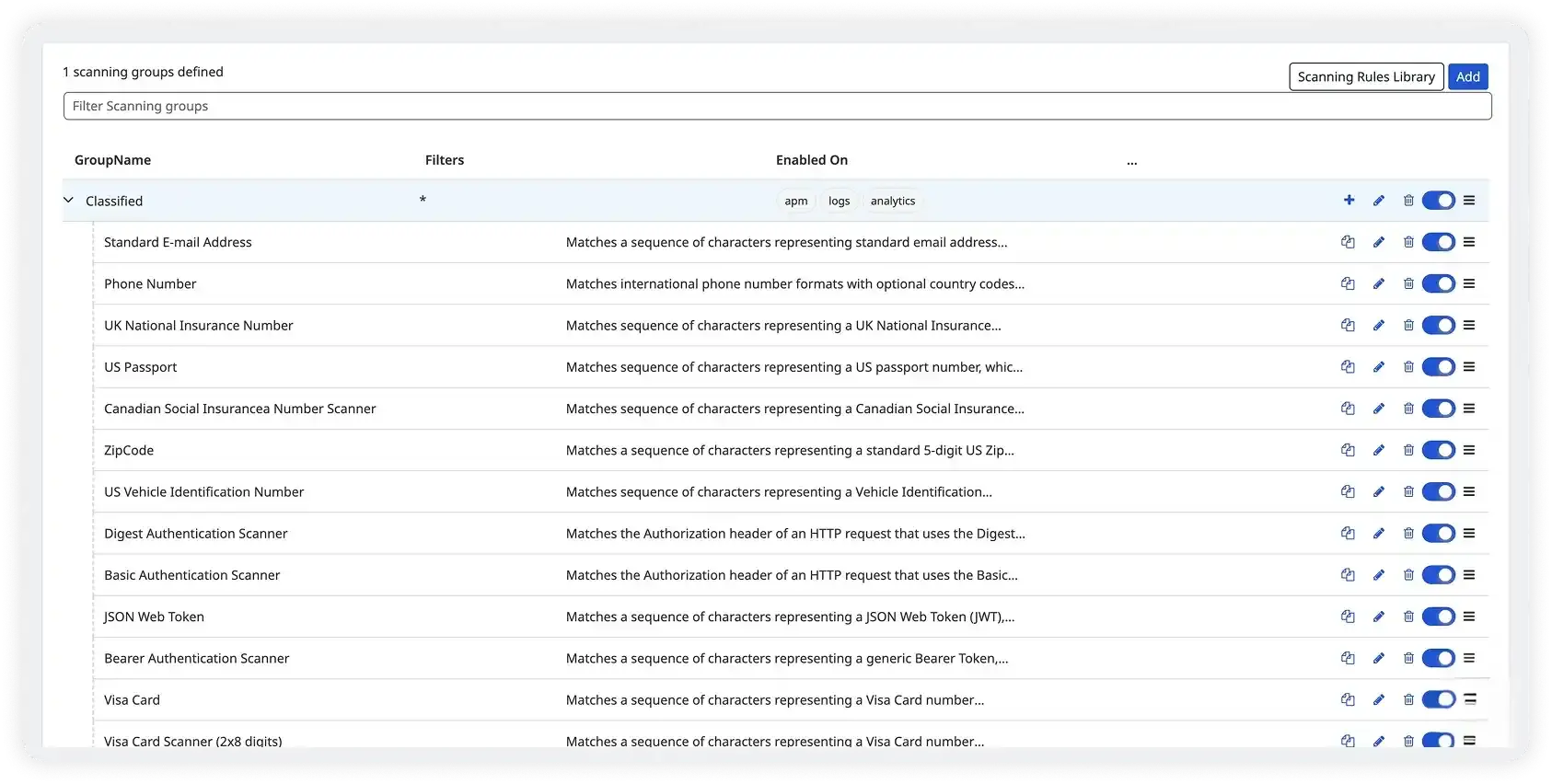
- Define Your Scanning Scope: Tag-based filters let you target specific services, environments, or log sources. New containers and hosts that match your tag selectors inherit scanning rules automatically.
- Match via Regex + Checksum Validation: Each event is scanned using PCRE regex patterns combined with format validators. Credit card detection runs the Luhn algorithm to confirm card number validity. JWTs are matched by structure. This combination dramatically reduces false positives versus naive pattern matching.
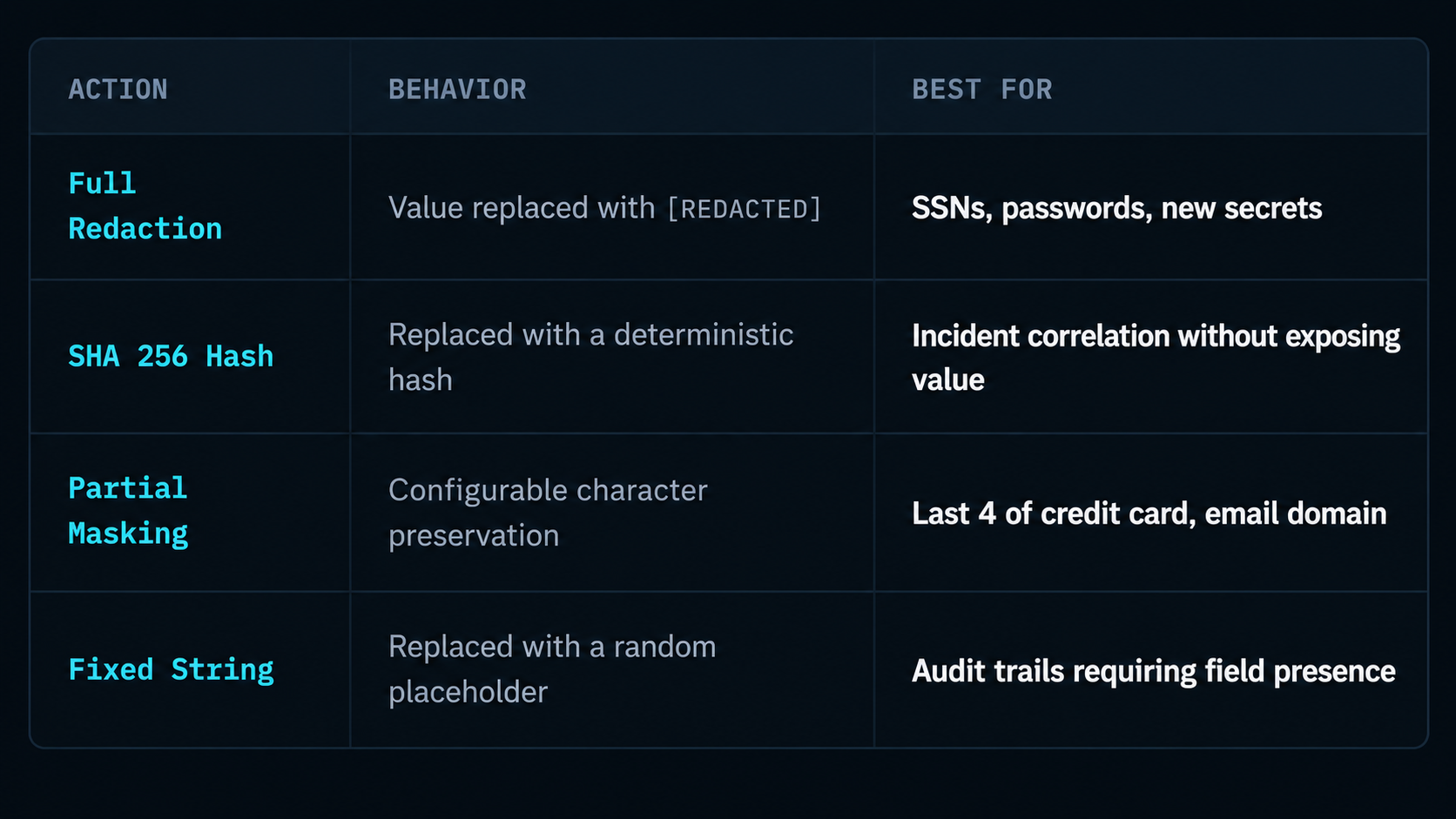
- Redact, Hash, or Mask - Configurable Per Rule: When a sensitive value is matched, you choose the action: full redaction, SHA-256 hashing (reversible by authorized users), partial masking with configurable character preservation, or replacement with a fixed string. The original value is never stored.
- Enrich, Alert, and Route Clean Data: Tag-driven dashboards show sensitive data volume, match trends, and risk distribution by service and rule tier. Alert on detection spikes in real time. Route clean, post-redaction telemetry to third-party destinations, your downstream tools receive only safe data.
Redaction Action Reference
What Gets Detected Out of the Box?
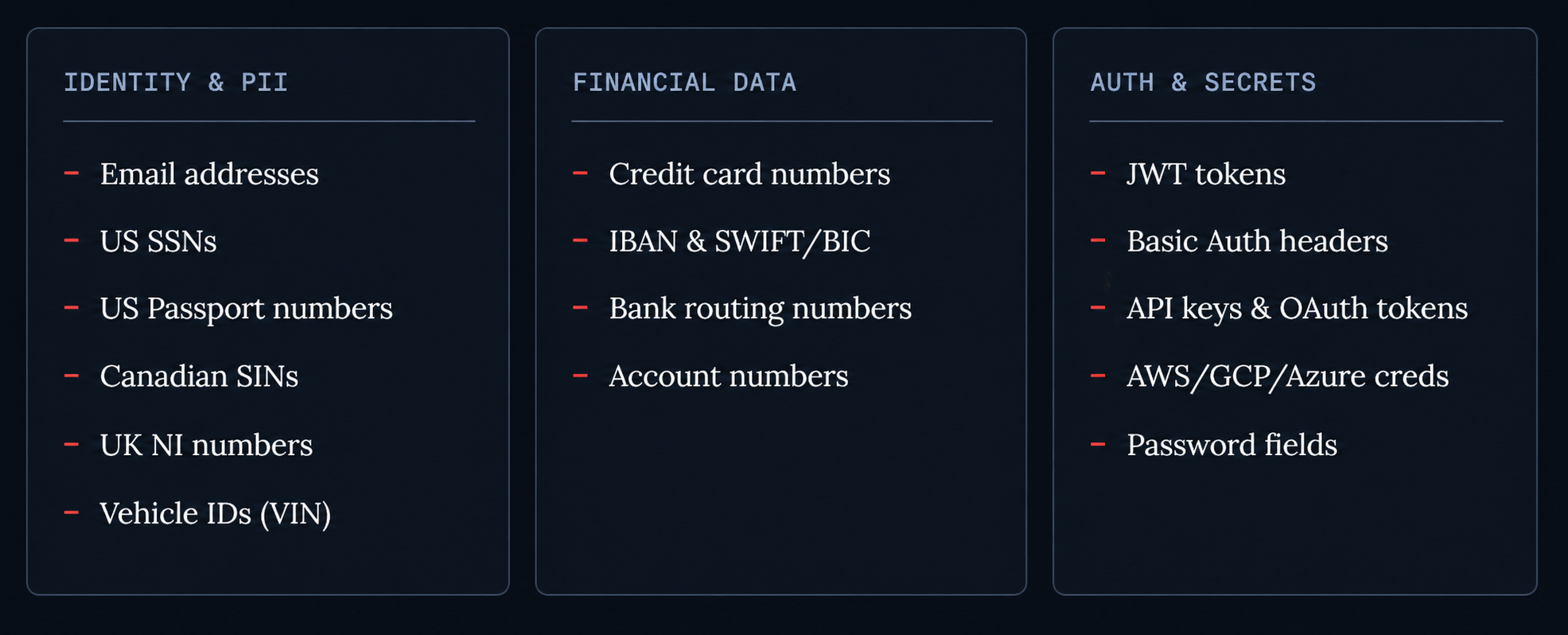
Atatus ships with 30+ production-ready detection rules covering the most common sensitive data types across financial, identity, healthcare, and infrastructure domains.
⚙ Custom Rules: Define your own patterns using PCRE regex with configurable confidence thresholds and character preservation. Internal employee IDs, proprietary token formats. If it has a pattern, it can be detected.
Real-World Scenarios Where Sensitive Data Leaks Into Observability
Scenario #1 - API Request Logging Captures Bearer Tokens
An API gateway logs the full request context for debugging. A developer traces a 401 error and logs the Authorization header. That JWT token is now indexed in your log platform, visible to anyone with query access, and shipped to your SIEM. Atatus matches the JWT at ingestion and replaces it with a SHA-256 hash, preserving correlation without exposing the live credential.
Scenario #2 - Kubernetes Workloads Leaking Secrets
A containerized service reads a secret from an environment variable and logs its startup configuration including that secret for operational visibility. Across dozens of services, this pattern compounds. Tag-based scanning ensures every new pod in your production namespace is automatically covered from its first log event.
Scenario #3 - Debugging Logs Exposing Customer PII
A support escalation triggers verbose debug logging. The trace captures a user's full name, email, and phone number from a form submission payload. Without PII detection in logs, this customer data sits in your observability platform indefinitely, a GDPR violation waiting for a regulator's audit request.
Scenario #4 - Distributed Traces Carrying Sensitive Metadata
APM spans propagate trace context across services. A payment service attaches card metadata to a span for correlation. By the time the trace reaches your backend, it has touched five services, three queues, and your storage layer. Ingestion-time redaction catches it at the first hop before it propagates anywhere.
Stop accidental PII leaks in logs and traces
Secure your entire observability stack - logs, APM spans, RUM events, and pipeline data.
How Atatus Protects Sensitive Data Across Logs, Metrics, and Traces?
Atatus Sensitive Data Classifier operates across every telemetry signal in your stack:
- Log Management: Full-text scanning of structured and unstructured log payloads at ingestion.
- APM Traces: Span attribute and metadata scanning across distributed service traces.
- RUM Events: Browser and mobile event data including form fields and API responses.
- Observability Pipelines: Redaction before data leaves your network and clean telemetry to downstream destinations with sensitive payloads stripped at source.
The detection engine is not a post-processing job. It is embedded in the ingestion path. Sensitive data never reaches indexes, long-term storage, or third-party integrations.
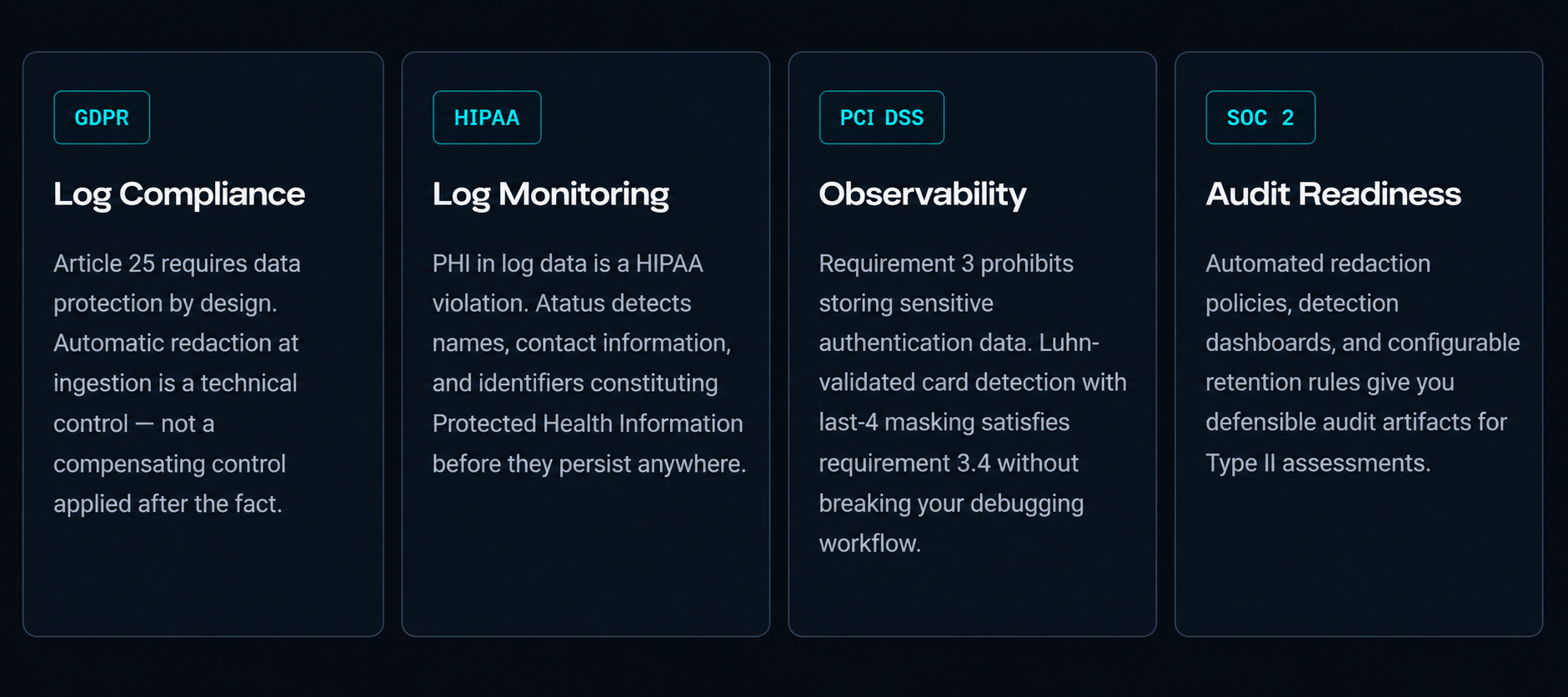
Compliance Coverage: GDPR, HIPAA, PCI DSS, and SOC 2
Automated sensitive data discovery and real-time redaction directly support your compliance obligations across all major frameworks.
Best Practices for Secure Observability
- Classify before you ingest. Treat every telemetry pipeline as a potential path for sensitive data. Define your scanning scope broadly and narrow based on performance data.
- Use SHA-256 hashing for correlatable fields. Full redaction breaks incident investigation. Hashing preserves the ability to correlate events across services without exposing the raw value.
- Apply tag-based scanning to every new environment automatically. Ensure Kubernetes namespaces, ECS clusters, and cloud workloads inherit detection rules at provisioning time. Manual rule assignment doesn't scale.
- Alert on detection spikes, not just detection presence. A sudden spike in credit card detections from a single service may indicate a code change that accidentally expanded logging scope.
- Redact at source before third-party routing. When fanning out to Datadog, Splunk, or cloud storage, apply redaction before data leaves your network.
⚠ Common mistakes to avoid: Sampling your sensitive data scan (100% coverage is non-negotiable for compliance). Relying on developers to sanitize logs manually. Treating PII detection as a one-time setup task. Forgetting RUM and APM spans as sensitive data sources.
Security and Compliance Checklist
- Sensitive data scanning enabled on all production log sources
- APM span attributes included in detection scope
- RUM events scanned for PII before storage
- JWT and API key detection rules active across authentication services
- Credit card detection with Luhn validation enabled for payment services
- Custom regex rules defined for internal identifier formats
- Detection spike alerts configured per service and risk tier
- Third-party pipeline destinations receiving only post-redaction data
- SHA-256 hashing applied to fields required for incident correlation
- Compliance evidence dashboards configured for GDPR, HIPAA, PCI DSS, SOC 2
The Observability Platform That Takes Security Seriously
Atatus Sensitive Data Classifier gives you the automation to fix it before it becomes a breach.
Frequently Asked Questions
What types of sensitive data does Atatus Sensitive Data Classifier detect?
Atatus detects PII (emails, SSNs, passport numbers), financial data (credit cards, IBAN, routing numbers), authentication credentials (JWT tokens, API keys, Basic Auth headers, AWS/GCP/Azure secrets), and custom patterns defined via PCRE regex, covering 30+ sensitive data types out of the box.
Does sensitive data scanning affect observability performance?
No. The scanning engine adds less than 5ms of latency at ingestion and operates at petabyte scale across 100% of your telemetry stream, not a sampled subset. Every event is scanned, every time.
Can I define custom sensitive data patterns beyond the built-in rules?
Yes. Atatus supports custom PCRE regex rules with configurable confidence thresholds, match actions, and character preservation settings for internal token formats, proprietary identifiers, or any structured pattern.
Does Atatus store the original sensitive value before redacting it?
No. Redaction happens in-stream at the point of ingestion. The original value is never written to storage, indexes, or third-party destinations. There is no exposure window.
How does Atatus help with GDPR and HIPAA compliance in log data?
Automatic PII redaction at ingestion satisfies data minimization principles under GDPR Article 25 and prevents PHI from persisting in log storage under HIPAA. Atatus provides detection dashboards and audit-ready evidence for both frameworks.
#1 Solution for Logs, Traces & Metrics
 APM
APM
Kubernetes
Logs
Synthetics
RUM
Serverless
Security
More

![New Relic vs Splunk - In-depth Comparison [2026]](/blog/content/images/size/w960/2024/10/Datadog-vs-sentry--19-.png)
![New Relic vs Sentry - Which Monitoring Tool to Choose? [2026]](/blog/content/images/size/w960/2024/10/VS--1-.png)