Detect Suspicious Container Behavior
Identify cryptomining, reverse shells, and lateral movement attempts in real-time. Alert before exfiltration occurs with process-level monitoring and behavioral anomaly detection.
Real-time visibility into container behavior, runtime threats, and compliance posture. Monitor every pod, trace every interaction, secure every workload across your cloud-native infrastructure.
Platform engineering and security teams select Atatus for unified observability combined with deep security capabilities.
Unified Observability + Security One platform for metrics, logs, traces, and security events. No context switching. No integration tax. See everything across your Kubernetes environment.
Cloud-Native Design Built for Kubernetes and containers. Deployed as a DaemonSet, zero modification to workloads. Scales with your infrastructure automatically.
Real-Time Threat Detection Runtime security monitoring with behavioral anomaly detection. Detect container escapes, privilege escalation, and suspicious activity as it happens.
Fast Incident Investigation Correlated telemetry from all layers. Distributed tracing shows service dependencies and root cause in minutes instead of hours.
Atatus connects observability and security. Monitor metrics, logs, and traces from every node, pod, container, and service, then correlate telemetry to detect threats, enforce compliance, and accelerate incident response.
See everything happening in your Kubernetes environment. From node-level infrastructure metrics to container process behavior, from API calls to distributed service transactions.
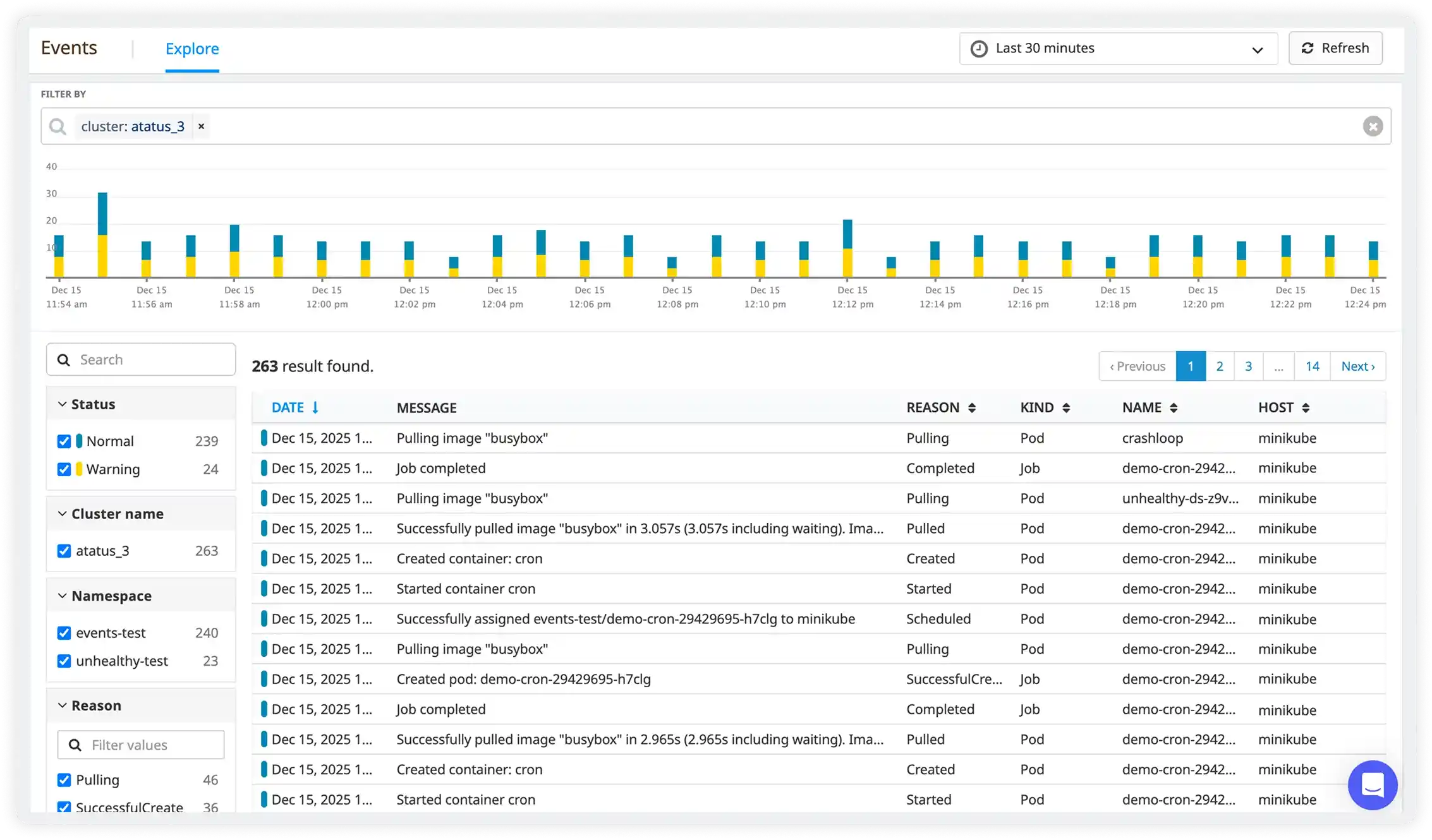
Every layer, every service, every workload integrated into one observability and security platform for cloud-native environments.
Baseline normal behavior and detect statistical anomalies. Identify unusual resource usage, network patterns, or workload behavior that could indicate compromise.
Map service-to-service communication patterns, network flows, and DNS resolution. Identify unexpected connections and understand blast radius for security incidents.
Capture all API server activity. Track user authentication, authorization decisions, resource changes, and RBAC violations for audit trails and compliance reports.
Distributed tracing and service dependency mapping reveal the full blast radius. Understand why a pod crashed or why a service is degraded.
Identify cryptomining, reverse shells, and lateral movement attempts in real-time. Alert before exfiltration occurs with process-level monitoring and behavioral anomaly detection.
Traces, logs, and metrics combined show exactly what happened before a pod crashed. Root cause analysis instead of speculation. Reduce MTTR from hours to minutes.
Track every API call, who made it, what changed, and the outcome. Detect unauthorized access attempts, privilege escalation, and policy violations from audit logs.
Node pressure, resource contention, and scheduling issues become visible instantly. Correlate infrastructure metrics with workload behavior to optimize both performance and security.
Distributed tracing shows the exact service call causing slowness. Network topology reveals latency from service-to-service communication and dependency analysis.
Identify unusual network connections, privilege escalation attempts, and cross-namespace access violations. Behavioral baselines catch anomalies humans would miss.
Atatus adapts to how engineering teams work across development, operations, and reliability.
Debug errors and slow paths with the full context of what happened.
Atatus for developersTrack deployments and see how each release affects stability.
Atatus for DevOpsWatch latency and error rates to ship with less production risk.
Atatus for release engineers"Solid Product even better support." The integration path is incredibly simple/easy and the overall interface is very intuitive. That said, I had a handful of odd use cases that the support team was incredibly responsive in helping me work through.
Pricing, deployment, data and the agent. If something is missing, a person will answer it on a demo call.
Kubernetes security encompasses protecting containerized applications and infrastructure across container orchestration platforms. It includes threat detection, vulnerability management, compliance enforcement, and operational visibility across distributed microservices architectures. Effective Kubernetes security requires monitoring runtime behavior, controlling access through RBAC and network policies, and maintaining audit trails across API activity and workload changes.
Kubernetes runtime security monitoring tracks the behavior of running containers and pods. This includes monitoring system calls, process execution, network connections, file system activity, and privilege escalation attempts. Runtime monitoring detects threats that occur after a container has started, including cryptomining, reverse shells, data exfiltration, and container escape attempts, threats that static scanning alone cannot catch.
Kubernetes observability is the ability to understand what is happening inside your cluster through metrics, logs, and traces. When combined with security monitoring, observability enables rapid threat detection and incident investigation. You can correlate security events with operational data to understand the full context, why a workload is behaving anomalously, what triggered an alert, and what the blast radius of an incident is.
Kubernetes security best practices include: (1) container image scanning for vulnerabilities, (2) least-privilege RBAC for workloads and service accounts, (3) network policies restricting pod-to-pod communication, (4) pod security policies or standards enforcing security contexts, (5) audit logging on API server activity, (6) secrets management and encryption at rest, (7) runtime threat monitoring for anomalous behavior, (8) compliance checks against CIS Kubernetes Benchmark, and (9) regular security assessments and incident simulations.
Container vulnerability management includes image scanning in CI/CD pipelines, scanning running containers in registries, and runtime scanning to detect post-deployment vulnerabilities. Scanning should cover OS packages, application dependencies, and language libraries. Findings should be prioritized by exploitability and business context, not just CVSS score. Remediation workflows should track patch status and enforce policies preventing vulnerable containers from running.
Atatus provides unified observability combined with security capabilities. Deploy once, get metrics, logs, traces, and security monitoring simultaneously. Atatus captures API audit logs, runtime behavior, container events, and network activity, then correlates everything to enable fast threat detection and incident investigation. The platform includes automated CIS and NSA/CISA compliance checks, reducing the need for separate security tools and integrations.
Root cause analysis (RCA) in Kubernetes involves understanding the chain of events leading to an incident. Distributed tracing shows service dependencies and request flows. Correlated logs reveal what happened at each layer. Metrics show resource constraints or saturation. Together, they explain why a pod crashed, why latency increased, or why a security alert fired. Effective RCA dramatically reduces MTTR and prevents recurrence through lessons learned.
Start free and send your first trace with OpenTelemetry or the Atatus agents. APM, logs, RUM, infrastructure and SIEM, all on one timeline.