
Stop Sensitive Data Leaks
Before They Happen
Discover, classify, and redact PII, credentials, and regulated data across logs, traces, RUM events, and cloud storage in real-time, at petabyte scale.
30+
Production-Ready Detection Rules
<5ms
Scan Latency at Ingestion
100%
Stream Coverage
2×
Faster Incident Resolution
Real-Time Scanning at the Point of Ingestion
Data is scanned and mutated in-flight, before it ever persists to storage. Zero re-processing. Zero retroactive exposure risk.
Define Scanning Scope
Use tag-based filters to target specific services, environments, or log sources. Apply rules selectively to logs, APM spans, RUM events, and pipeline data.
Match via Regex + Validation
Rules run against each event using regex patterns combined with checksum validators (e.g. Luhn algorithm for credit cards) to minimize false positives.
Redact, Hash, or Tag
Matched values are fully redacted, hashed (SHA-256), or partially masked. The original value is never stored. Actions are configurable per rule.
Enrich & Route
Without segmented insights, it is difficult to see which clients or consumers generate the most traffic over time.
What Gets Detected Out of the Box?
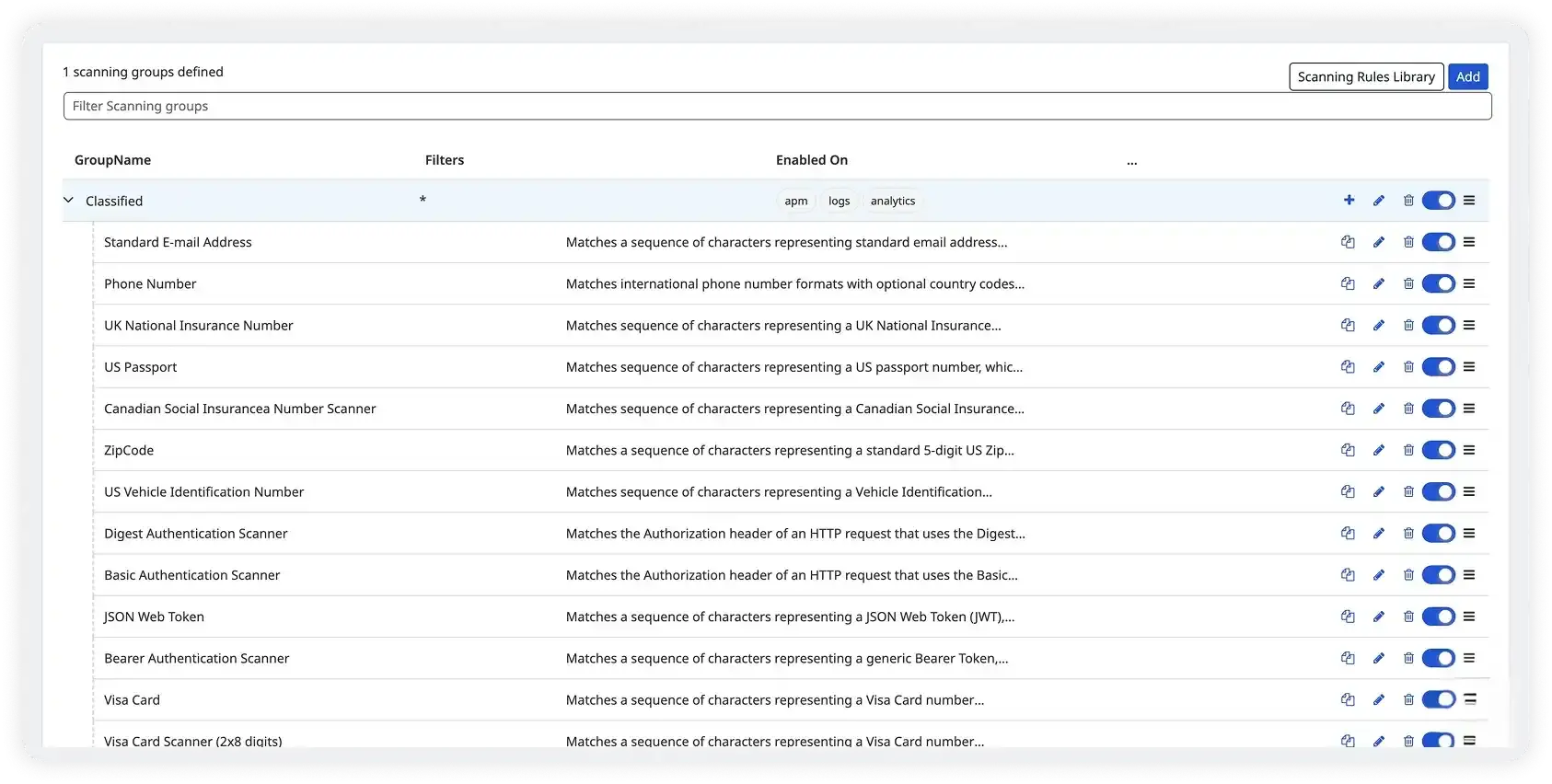
Built-in rules cover the most common sensitive data types across financial, healthcare, identity, and infrastructure domains.
Detect exposed business and personal emails to prevent phishing, data harvesting, and account takeover risks
Identify leaked NI numbers with strict format validation to reduce identity fraud exposure
Flag sensitive passport identifiers to prevent credential abuse and compliance violations
Detect high-risk SIN data with checksum validation to mitigate identity theft threats
Identify exposed VINs that can be exploited for fraud, cloning, or unauthorized vehicle record access
Detect Base64-encoded Basic Auth headers to prevent hardcoded credential exposure
Identify exposed bearer tokens and signed JWTs to stop session hijacking and API abuse
Detect payment card numbers, IBAN, routing numbers, and SWIFT codes to prevent financial data breaches and PCI risk
Everything You Need for Enterprise Data Security
Purpose-built for SecOps, platform engineering, and compliance teams running cloud-native stacks.
Automatic Discovery
Scan new hosts, containers, and services the moment they spin up. No manual rule assignment. New environments inherit scanning groups via tag selectors.
Zero-touch onboarding
30+ Validated Rules Library
Out-of-the-box rules for credit cards, SSNs, passport numbers, IBAN, API keys, OAuth tokens, AWS/GCP/Azure credentials, and more. Maintained and updated continuously.
Updated continuously
Custom Regex Rules
Define your own patterns using standard PCRE regex. Set match confidence thresholds, character preservation rules, and custom tag schemas for internal data types.
PCRE support
Multiple Redaction Strategies
Full redaction, SHA-256 hashing (reversible by authorized users), partial masking with configurable character preservation, or replacement with a fixed string.
4 action types
Observability Pipelines Integration
Redact before data leaves your network entirely. Route clean telemetry to Datadog while keeping sensitive payloads out of any third-party destination.
On-prem redaction
Dashboards & Alerting
Tag-driven dashboards show sensitive data volume, match trends, and risk distribution. Alert on spike in detections per service, rule, or risk tier in real-time.
Metric-based alerts
From Telemetry Event to Safe Storage
Scanning happens in-stream. Sensitive values never reach indexes, long-term storage, or third-party integrations.
Source
Telemetry Ingestion
Logs, APM traces, RUM events, CI pipelines, and cloud storage unified ingestion point.
Filter
Scope Evaluation
Tag-based query filters route events to the correct scanning group in <1ms.
Scan
Pattern + Validation
Regex engine runs in parallel with secondary validators (Luhn, format checks) for precision.
Action
Mutate & Enrich
Values are redacted / hashed. Risk tags are appended. Audit record created.
Output
Safe Persistence
Clean, enriched events reach indexes and dashboards. Sensitive payload gone from the wire.
Scans Every Data Stream in Your Stack
No agents, no sidecars, no additional infrastructure. SDS plugs directly into Atatus unified ingestion pipeline.

Log Management: All log sources: agents, lambda, syslog, HTTP endpoint, cloud forwarders
APM / Distributed Tracing: Span tags, HTTP body attributes, SQL queries, gRPC request metadata
Real User Monitoring (RUM): Browser and mobile events, session data, error payloads
Trusted by Security & Platform Teams
“We scanned over 50TB of existing log data and found production PII that had been silently leaking for months. The out-of-box rules saved us weeks of regex development.”
Andrew Mitchell
Principal Security Engineer
“The HIPAA rule pack was immediately actionable. We went from zero coverage to full PHI redaction in our production logs within a single afternoon. Compliance team signed off in days.”
Melissa Reynolds
Head of Platform Engineering
“Being able to combine SDS with restriction queries means our customer support team can use logs for debugging without ever seeing raw PII. That's a genuine architectural win.”
Daniel Carter
Staff Infrastructure Engineer